Skip to content

Prešporok · the coronation city

Neighborhoods

Discover the diverse districts that make up Slovakia's capital

Photo by michael schaffler on Unsplash

Bratislava is divided into five districts and 17 boroughs, but as a visitor, you'll likely focus on a handful of key neighborhoods. Each has its own character, from medieval Old Town to the brutalist towers of Petržalka.

The single fact that explains the city's layout is the river. The Danube cuts Bratislava in two: the historic core, the castle hill, and the older residential slopes all sit on the north bank, while the south bank is given over almost entirely to Petržalka, the vast residential borough reached by tram or on foot across the bridges. Most of what a visitor comes to see — the squares, the cathedral, the city gate, the street statues — is packed into the Old Town on the north side, so the two halves of the city feel very different the moment you cross the water.

In practice you will spend most of your time in the Old Town plus a small cast of distinct neighbourhoods: leafy, well-off Palisády behind the castle; the forested edges of Nové Mesto; the green riverside of Karlova Ves; the practical eastern borough of Ružinov; and Petržalka across the river. Because the city is compact, these neighbourhoods are only minutes apart by foot, tram, or bus, so you never have to commit to one — you can base yourself in the historic centre and dip into the others, or stay somewhere quieter and cheaper and treat the Old Town as a place you visit.

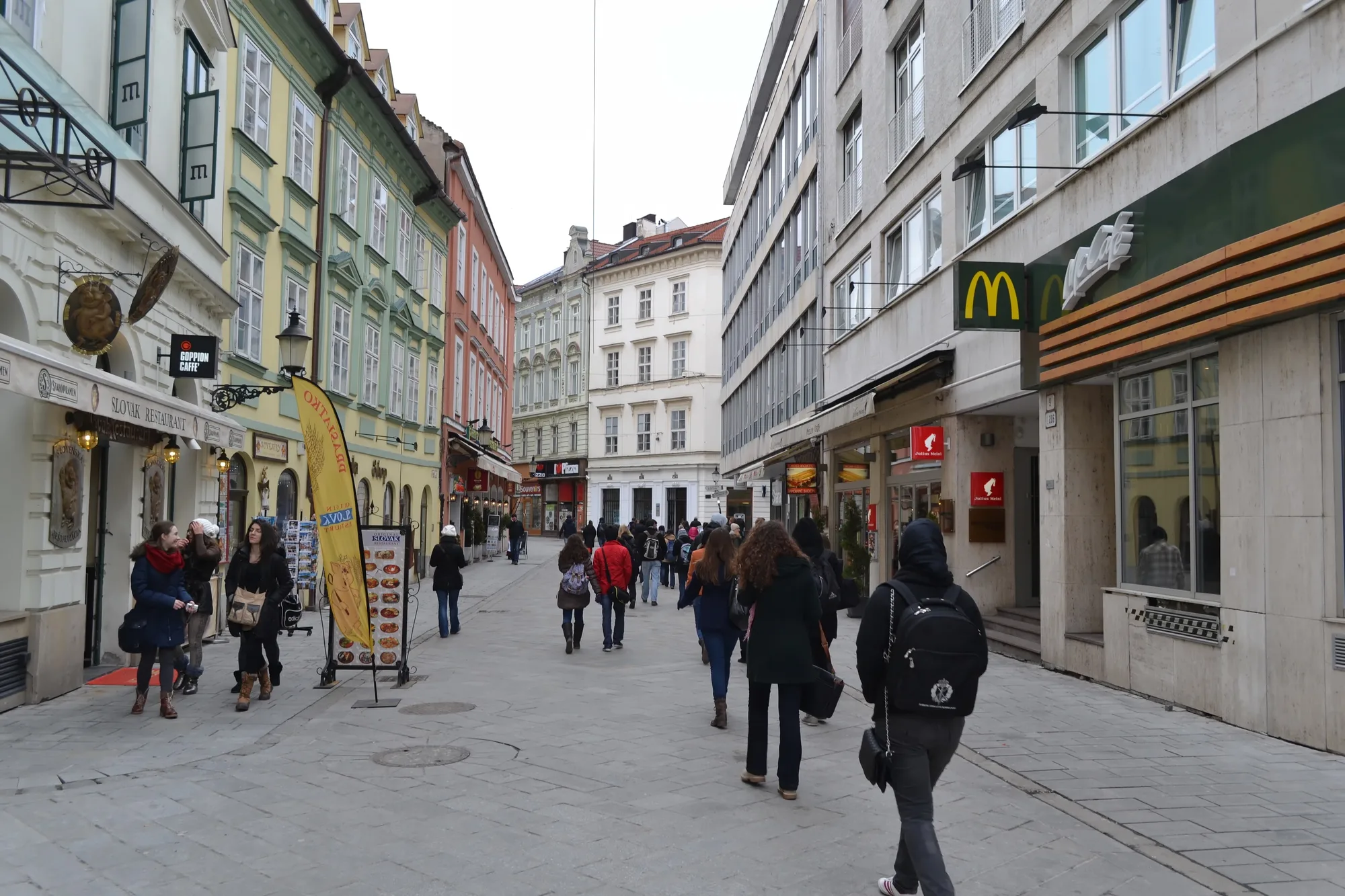
A pedestrian lane lined with historic townhouses in Bratislava’s Old Town
The Old Town (Staré Mesto) is the historic heart.Photo: Slyronit · CC BY-SA 4.0 · Wikimedia Commons
Buildings and greenery in central Bratislava
Historic, touristy, charming

Stare Mesto (Old Town)

The historic heart of Bratislava and the part almost every visitor comes for. This is where a thousand years of the city is concentrated into a few hundred metres: medieval lanes opening onto the main square, Baroque palaces in faded pink and ochre, a coronation cathedral, and the surviving city gate. It is compact and entirely walkable, with most of the headline sights five to twenty minutes apart on foot, so you can wander without ever consulting a transport map. The streets carry the heaviest tourist footfall in the country, yet they thin out quickly in the evening when day-trippers leave, and the cafe terraces, wine bars, and the famous bronze street statues come into their own. It is the most expensive corner of the city and the most polished, but it is also the one that delivers the postcard Bratislava on the shortest stay.

Highlights

Hlavne namestieMichael's GateSt. Martin's CathedralBest cafes and restaurants

Best for: First-time visitors, sightseeing, dining out

Tip: Stay here for convenience and atmosphere, but walk or take a tram into one of the ring boroughs at least once for a more local, lived-in feel — and better value on food.
A cobbled lane of pastel townhouses below Bratislava Castle in the Old Town
Urban, residential, surprising

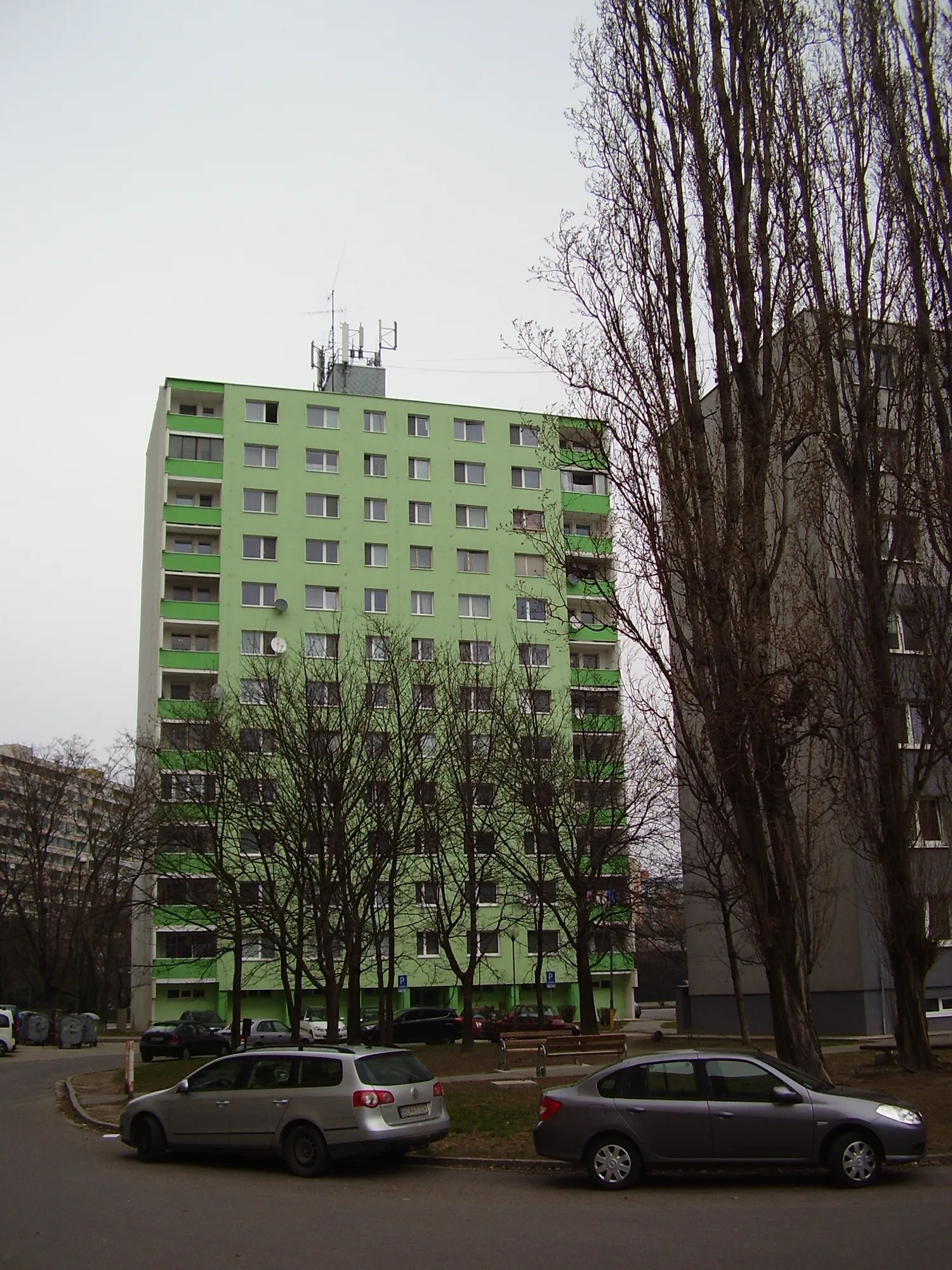
Petrzalka

Spread across the south bank of the Danube and reached by tram or on foot across the bridges, Petržalka is the largest borough and the most densely populated residential district in Central Europe, defined by its vast estates of communist-era paneláky — the prefabricated concrete apartment towers that house a sizeable share of the city. First impressions are of repetition and grey, but the towers have been repainted in blocks of colour over the years, and there is far more here than concrete: one of Europe's oldest public parks runs along the riverbank, a revitalised waterfront draws walkers and cyclists, and the everyday rhythm of a real residential district plays out in its markets, bus stops, and corner shops. For a visitor it is less a sight than a window into how most of the city actually lives, and accommodation here tends to be noticeably cheaper than across the water.

Highlights

Janko Kral ParkTyrsak BeachStreet artColorful building facades

Best for: Architecture lovers, locals scene, budget accommodation

Tip: Cross the bridge on foot for the river views, then walk the green riverbank and Sad Janka Kráľa park rather than wandering deep into the estates, where there is less for a visitor to see.

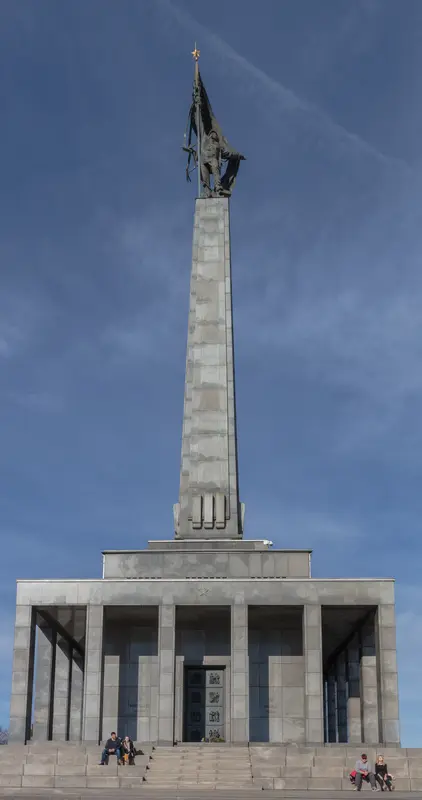
The Slavín war memorial in Bratislava — a tall stone pylon topped by a bronze soldier
Upscale, quiet, residential

Palisady

The genteel residential slope rising behind Bratislava Castle, Palisády has long been where the city's well-off and its diplomats live, and it shows in the quiet, tree-lined streets, the embassies behind discreet gates, and the elegant older villas with their views back over the rooftops to the river. It feels a world away from the bustle of the squares below, yet the Old Town is only a short, mostly downhill walk away, which makes it one of the calmer places to stay within easy reach of the centre. There is little here in the way of attractions beyond the streetscape itself and the climb up to the Slavín memorial, but that is precisely the appeal: it is a neighbourhood for slow morning walks, leafy quiet, and the sense of a residential city that exists alongside the tourist core.

Highlights

Castle proximityEmbassy districtSlavin MemorialElegant villas

Best for: Peaceful stays, morning runs, luxury seekers

Tip: Walk up through here on your way to the Slavín memorial for some of the best free city views, and treat the gentle climb as part of the experience rather than a detour.

An autumn woodland trail in the forest park near Bratislava
Suburban, natural, relaxed

Nove Mesto (New Town)

Despite the name, "New Town" is not new and is not a single neighbourhood so much as a broad district sprawling north and north-east of the centre toward the wooded slopes of the Little Carpathians. Closer in it is a mix of older apartment streets, markets, and the standout Kamzík hill with its television tower; further up, areas like Koliba climb into the trees where the city dissolves into forest. It is quieter and more residential than the core, and its real draw for a visitor is access to nature — hiking and cycling trails, the Železná studnička valley with its ponds, and traditional restaurants where you eat with the forest at the edge of the terrace. It rewards anyone who wants to pair a city break with a few hours of green air without leaving the boundaries of Bratislava.

Highlights

Koliba areaZelezna StudnickaHiking trailsTraditional restaurants

Best for: Nature lovers, hikers, families

Tip: Head up to Koliba for traditional Slovak cooking with forest views, and pair it with a walk through the Železná studnička valley below for an easy half-day of green.

Bratislava’s skyline at dusk with the castle, St. Martin’s spire and a cargo boat on the Danube
Practical, suburban, local

Ruzinov

East of the centre, Ružinov is one of the city's big residential boroughs and the one most travellers brush against without realising it, since the airport and the largest shopping centre both sit within its bounds. It is practical rather than picturesque: leafy mid-century apartment streets, local parks and a lake, supermarkets, and the ordinary infrastructure of daily life, all knitted together by good tram and bus links back to the Old Town. There is little here that a sightseer would single out, but that is part of why it works for a longer stay — it is calmer and cheaper than the centre, well connected, and it gives you the texture of everyday Bratislava rather than its showpiece face. For anyone arriving late or leaving early it also has the obvious advantage of being the airport's own district.

Highlights

AirportAvion Shopping CenterLocal parksResidential areas

Best for: Airport convenience, shopping, longer stays

Tip: Pick a self-catering apartment here if you want to live like a local on a longer stay, and lean on the trams and buses to reach the centre rather than expecting much to see on the doorstep.

Green vineyard slopes under a blue sky in the Small Carpathians
Family-friendly, natural, quiet

Karlova Ves

Strung along the river west of the centre on the road toward Devín, Karlova Ves is a calm, green residential borough that is popular with families, students, and the international crowd drawn by the nearby university campuses and schools. Hills, gardens, and the edge of the Bratislava Forest Park give it an unhurried, almost suburban feel, while a quiet side-arm of the Danube offers a place to walk, paddle, and escape the city without going far. It is not a sightseeing destination, but it is one of the most liveable corners of Bratislava and a pleasant base for anyone staying longer or travelling with children, with the Old Town an easy tram ride away and the riverside route out to Devín Castle beginning more or less at its doorstep.

Highlights

Forest ParkKarloveske ramenoUniversity campusResidential quiet

Best for: Families, longer stays, nature lovers

Tip: Follow the quiet Danube side-arm at Karloveské rameno for a peaceful walk or paddle, and remember the riverside route on toward Devín Castle starts close by.

01 · Compare the Sides

Old Town vs Across the River

Two very different Bratislavas, split by the Danube — and how to decide which one to base yourself in.

The historic north bank

The Old Town and the slopes immediately around it — the castle hill and leafy Palisády — make up the Bratislava most visitors picture. This is the dense, walkable, atmospheric core: cobbled lanes, the coronation cathedral, the squares and street statues, and the lion's share of the cafes, restaurants, and hotels. It is the most expensive part of the city and the busiest by day, but it is also the only part you can fully explore on foot without ever touching public transport. If your trip is short, this is where you want to be based and where you will spend most of your time.

Across the river and the ring boroughs

Cross to the south bank or ride out to the eastern and western boroughs and Bratislava changes character completely. Petržalka's colour-blocked towers, Ružinov's leafy apartment streets, and Karlova Ves's green riverside are residential rather than scenic — fewer sights, more everyday life, and noticeably better value on food and accommodation. The trade-off is that you swap a five-minute walk for a short tram or bus ride into the centre. For a longer stay, or for travellers who want to feel how the city actually lives, that trade is often worth making.

How to choose between them

On a one- or two-night trip, the maths usually favours the Old Town: you pay more, but you waste no time getting to the sights and you get the postcard atmosphere on your doorstep. On a longer stay, or with a tighter budget or children in tow, a ring borough such as Ružinov or Karlova Ves earns its keep with space, calm, and local prices, while Petržalka offers the cheapest beds and the most direct tram links across the water. The city is compact enough that wherever you land, the other neighbourhoods are only minutes away, so the choice is really about what you want on your doorstep each morning rather than about being cut off from anything. A useful rule of thumb is to weigh how many nights you have against how much you mind paying a premium to step straight out into the sights.

Socialist-era panel apartment blocks in the Petržalka district of Bratislava
Across the river, Petržalka is Central Europe's largest panel-block estate.Photo: Kelovy · CC BY-SA 4.0 · Wikimedia Commons

02 · The Feel of the Districts

What Bratislava's Neighbourhoods Are Actually Like

Bratislava's neighbourhoods are best understood through the river. The Danube cuts the city in two: the historic core, the castle hill, and the older residential slopes sit on the north bank, while the south bank is given over almost entirely to Petržalka. For a visitor this means the experience is lopsided by design — you spend most of your time on the north bank, in and around a compact Old Town, and you cross the water mainly for a view, a park, or a cheaper bed. The bridges, rather than any grand boulevard, are the seams that hold the two halves together.

What surprises people is how quickly the polished centre gives way to ordinary life. A few minutes out of the squares and the souvenir shops thin, the cafes turn local, and you are among apartment streets, markets, and tram stops that have nothing to do with tourism. This is not a fault so much as the truth of a working capital that is still modest in size: the showpiece and the everyday sit side by side, sometimes on the same street. Travellers who treat that as part of the appeal — rather than a disappointment that the whole city is not a film set — tend to enjoy it far more.

Above all, Bratislava is compact, and that compactness shapes how its neighbourhoods feel. Distances are short, trams and buses are quick, and even the borough that climbs into the forest or the one that hugs the river toward Devín is a manageable ride from the centre. You do not have to pick one neighbourhood and commit to it; you can base yourself in the Old Town and dip into the others, or stay somewhere cheaper and quieter and treat the historic core as a place you visit. The neighbourhoods are distinct in character but never far apart, and that ease of moving between them is one of the quiet pleasures of the city.

03 · Transport

Getting Around

How to navigate between neighborhoods

Walking

Old Town and immediate surroundings are entirely walkable. Most attractions within 15-20 minutes on foot.

Trams

Lines 1 and 3 connect Petrzalka with Old Town. Great for crossing the river.

Buses

Extensive network reaching all neighborhoods. Bus 61 connects airport to center.

Apps

Use IDS BK app for public transport tickets, Bolt or Hopin for taxis.

04 · Questions

Frequently Asked Questions

Which neighbourhood should I stay in for a short visit?

For a one- or two-night trip, the Old Town (Staré Mesto) is the easiest choice: you are within a few minutes' walk of almost every headline sight, the cafes and restaurants are on your doorstep, and you never need transport for the core. It is the most expensive area, so if budget matters more than convenience, a ring borough such as Ružinov or Karlova Ves, or Petržalka across the river, gives you cheaper beds and a short tram or bus ride in. Room rates and travel times vary, so it pays to compare a couple of options when you book.

What is Petržalka actually like?

Petržalka sits on the south bank of the Danube and is the largest borough and the most densely populated residential district in Central Europe, built around vast estates of communist-era prefabricated apartment towers. First impressions can be of repetition and concrete, but the towers have been repainted in colour over the years, one of Europe's oldest public parks runs along the riverbank, and a revitalised waterfront draws walkers and cyclists. It is more a window into how the city lives than a sight in itself, and it offers some of the cheapest accommodation in Bratislava.

Is the Old Town the only interesting part of Bratislava?

It holds the most concentrated sightseeing — the cathedral, the squares, the city gate, the street statues — but it is not the whole story. The leafy Palisády slope behind the castle, the forested edges of Nové Mesto, the green riverside of Karlova Ves, and even the colour-blocked towers of Petržalka each have their own character and reward a short trip out. Most visitors rightly spend the bulk of their time in the Old Town, but a single venture into a ring borough gives a fuller, more local picture of the city.

How do you get between the neighbourhoods?

Within the Old Town you walk. Beyond it, the city runs an integrated public transport network of buses, trams, and trolleybuses under IDS BK, with trams crossing the river to Petržalka and bus 61 linking the airport to the main station. Tickets are time-based and cheap (roughly €1.20–1.80 a ride), so buy one before you board through the app or a machine. The city is compact, so most boroughs are only a short ride from the centre, and the IDS BK app shows the day’s fares and routes.

Which areas are best for nature or families?

For nature, head to Nové Mesto, whose northern reaches climb into the Little Carpathians with hiking trails and the Železná studnička valley, and to Karlova Ves, which hugs the river toward the Bratislava Forest Park and a quiet Danube side-arm. Both Karlova Ves and Petržalka also sit near large parks and green riverbanks. Families often favour Karlova Ves and Ružinov for their calm residential streets, space, and good transport links, with the cheaper, quieter feel that comes with staying outside the tourist core.

Is Bratislava walkable?

The Old Town is one of the most walkable centres in Europe, with the main sights five to twenty minutes apart on foot and no transport needed for the core. The wider city is larger and more spread out, but it is still compact by capital-city standards, and the gaps between the centre and the ring boroughs are easily closed by a short tram or bus ride. In practice you walk the historic heart and use public transport only to reach the river, the parks, the airport, or a day trip such as Devín, which is itself reachable by city bus across the river. Wear shoes that cope with cobblestones and treat the castle hill as a gentle climb rather than a hike.

Verify before you go

Sources & official links

We verify prices, hours, and dates against official pages. They change without notice — confirm time-sensitive details at the source before you go.

05 · Next Step

Ready to Choose Your Base?

Where to Stay Guide