 Photo: Wikimedia contributors · See source
Central Slovakia Mining Towns
Join Banská Štiavnica, Kremnica, Banská Bystrica, Vlkolínec and the Low Tatras edge over six days.
- Allow
- 6 days
- Route
- 648 km
- Drive time
- 7 hr 46 min
- Stops
- 6
Central Slovakia changes the scale of the journey. Banská Štiavnica embeds mining history in a volcanic landscape, Kremnica condenses another royal mining story, Banská Bystrica opens into a larger mountain city and Vlkolínec preserves a rare wooden settlement above Ružomberok.
Mountain weather and winter conditions are the real itinerary. This is a late-spring-to-autumn roadbook unless the driver and rental are fully winter-ready. Park below steep historic cores, check mine tours and never follow a shortcut onto a forest road.
The road, in one glance
Pinch or scroll with Ctrl / ⌘ to zoom
Drawing the route…
The route earns
its distance
Each pin is selected as a place to do something—not merely proof that you passed through.
 Photo: Wikimedia contributors · See source
Bratislava
Begin after the capital stay with a two-night mountain-town plan rather than daily hotel changes.
Bratislava (Hungarian: Pozsony; German: Pressburg) is the capital and largest city of Slovakia and the fourth largest of all cities on the river Danube. Officially, the population of the city proper is about 479,000, the wider Bratislava Region exceeds 732,000 inhabitants. The metropolitan area has a population of approximately 1.3 million.
 Photo: Wikimedia contributors · See source
Banská Štiavnica
Steep streets, mine history and tajchy reservoirs need two measured days.
Banská Štiavnica, pronounced ) is a town in central Slovakia, in the middle of an immense caldera created by the collapse of an ancient volcano. For its size, the caldera is known as the Štiavnica Mountains. Banská Štiavnica has a population of less than 10,000.
 Photo: Wikimedia contributors · See source
Kremnica
A fortified mining town and mint history form a compact highland stop.
Kremnica (; German: Kremnitz, Hungarian: Körmöcbánya) is a town in central Slovakia. It has around 5,300 inhabitants. The well-preserved medieval town built above important gold mines is the site of the oldest still-working mint in the world.
 Photo: Wikimedia contributors · See source
Banská Bystrica
A broad square and important modern history anchor the central mountain region.
Banská Bystrica is a city in central Slovakia, located on the Hron River in a long and wide valley encircled by the mountain chains of the Low Tatras, the Veľká Fatra, and the Kremnica Mountains. With approximately 76,000 inhabitants, Banská Bystrica is the sixth most populous municipality in Slovakia. The present-day town was founded by German settlers who were invited by the Hungarian Árpád kings during the Middle Ages (as part of the Ostsiedlung), but it was built upon a former Slavic/Slovak/Avar settlement.
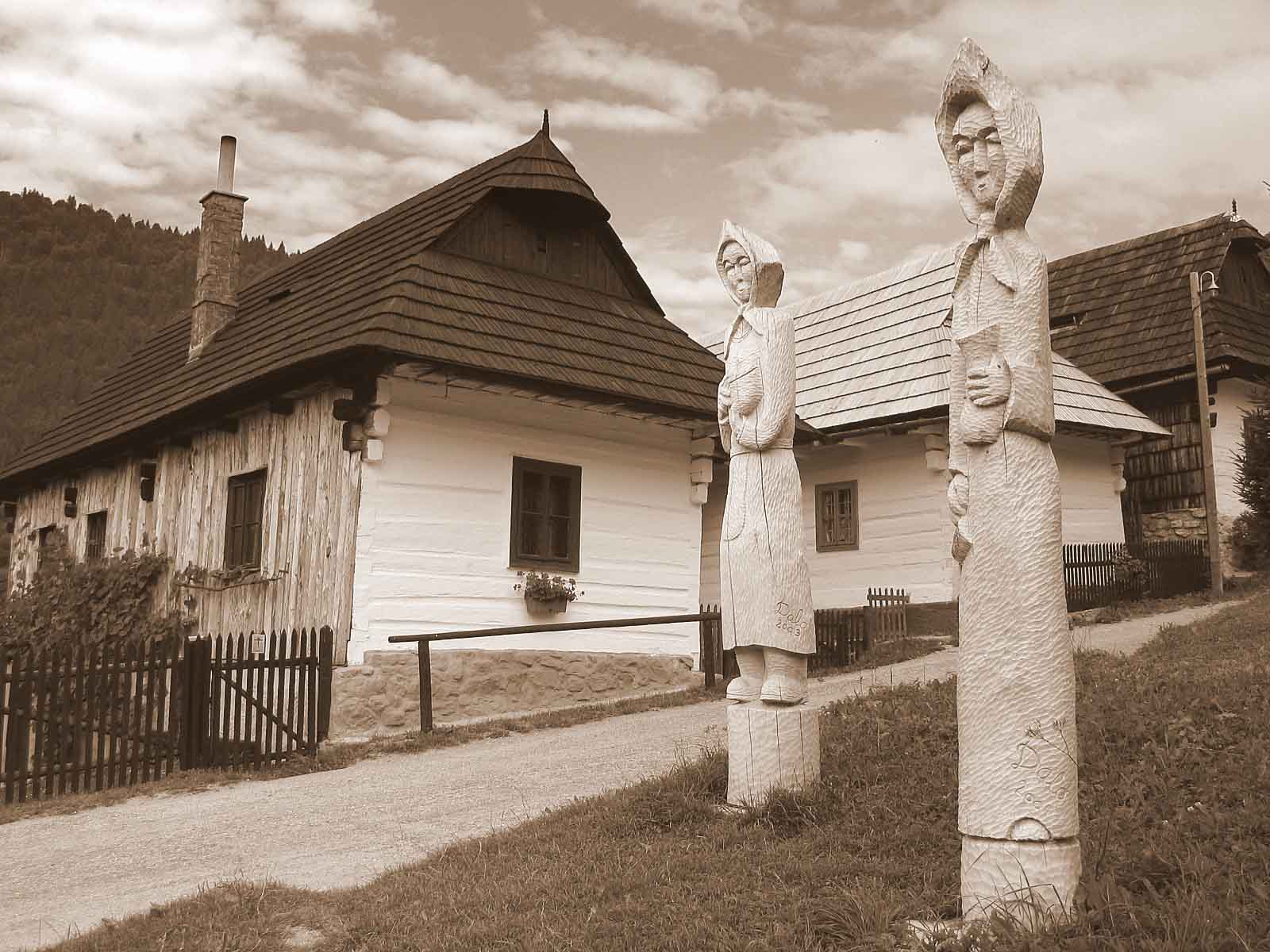
Photo: Wikimedia contributors · See sourceVlkolínec
A living wooden mountain settlement preserves a distinctive Carpathian landscape.
Vlkolínec is a village under the administration of the town of Ružomberok in Slovakia. Historically, however, it was a separate village. The first written mention of the village came from 1376 and after 1882 it became part of Ružomberok.
 Photo: Wikimedia contributors · See source
Demänovská Valley
Caves and a Low Tatras valley provide an outdoor turn before the long return west.
Demänovská Dolina (Hungarian: Deménvölgy) is a village and municipality in Liptovský Mikuláš District in the Žilina Region of northern Slovakia. More precisely, it is situated in Demänovská valley, where Demänovská Cave of Liberty and Demänovská Ice Cave can be found.
Drive the conditions,
not the itinerary.
Check mountain weather and winter equipment rules, use only paved public access and plan the longer rural legs before dark.
Checked against
the people who run it
Distances and driving times are planning estimates. Conditions, closures, ferries, permits and park rules can change, so check the linked official guidance before setting out.